
- Home
- Explore Insurance
- Explore More
- Office Package Policy
- Personal accident policies
- Pet Insurance cover
- Professional Indemnity and Liability including E&O Policy
- Pvt Car TP and CV TP In India
- Shop Insurance
- Standalone OD Policy
- Surety Bond Policy
- Travel Insurance in India
- Two Wheeler Insurance In India
- Wedding or event Insurance Policy
- Workman compensation policy
- About Us
- Contact Us

Group Personal Accident Policy GPA
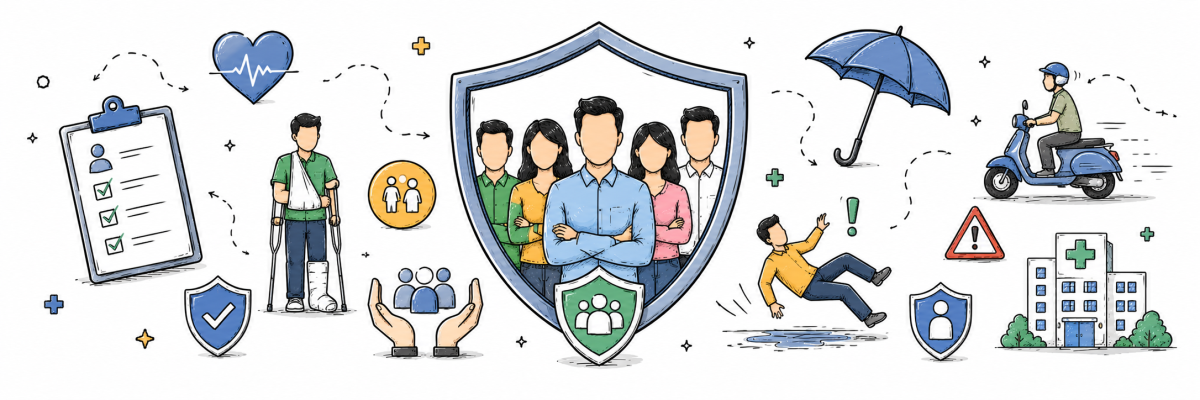
In 2026, Group Personal Accident (GPA) Insurance in India serves as a vital financial safety net for organized groups—primarily employees—providing fixed-benefit compensation for accidents regardless of where they occur.
Key Coverage & Benefits
GPA policies are typically "benefit-based," meaning they pay a predetermined lump sum or weekly amount based on the severity of the injury, rather than just reimbursing medical bills.
Accidental Death
Nominees receive 100% of the sum insured.
Permanent Total Disability (PTD)
Pays 100% of the sum insured for life-altering injuries such as loss of two limbs, loss of sight in both eyes, or total paralysis.
Permanent Partial Disability (PPD)
Pays a fixed percentage (e.g., 5% to 50%) for the loss of specific body parts like a finger, toe, or sight in one eye.
Temporary Total Disability (TTD)
Provides a weekly allowance (often the lesser of 1% of sum insured or ₹5,000) for a specified period (up to 100 weeks) if the insured is on mandatory bed rest and cannot work.
Additional Benefits
Child Education Grant
A one-time payment for the education of dependent children (often up to ₹10 lakh).
Ambulance & Transportation
Coverage for ambulance charges and the cost of transporting mortal remains.
Lifestyle Modification
Funds to adapt a home or vehicle for disability support.
Common Exclusions (2026)
Policies generally do not cover:
Natural Death
Only deaths resulting directly from an accident are covered.
Intoxication
Injuries sustained while under the influence of alcohol or drugs.
Self-Inflicted Injury
Claims arising from attempted suicide or intentional self-harm.
Hazardous Activities
Participation in adventure sports (e.g., bungee jumping) unless a specific rider is purchased.
Legal Violations
Injuries sustained while committing a crime or participating in civil unrest.
Eligibility and Costs
Who is Covered
Full-time, part-time, and contractual employees, as well as business owners and board members.
Standard Age Limits
Generally covers individuals from 18 to 70 years.
Premiums
GPA is highly cost-effective; in 2026, premiums can be as low as ₹100 to ₹600 per employee per year for significant coverage (e.g., ₹7–10 lakh), depending on the industry's risk profile.